
DuneSpan / Platform overview

Platform overview
Five native modules on one governed platform
DuneSpan spans the systems an industrial company already runs, structures its engineering, operational and sustainability data, and scales governed AI across the organisation.
Architecture · Version 2, October 2026
One architecture across the industrial lifecycle
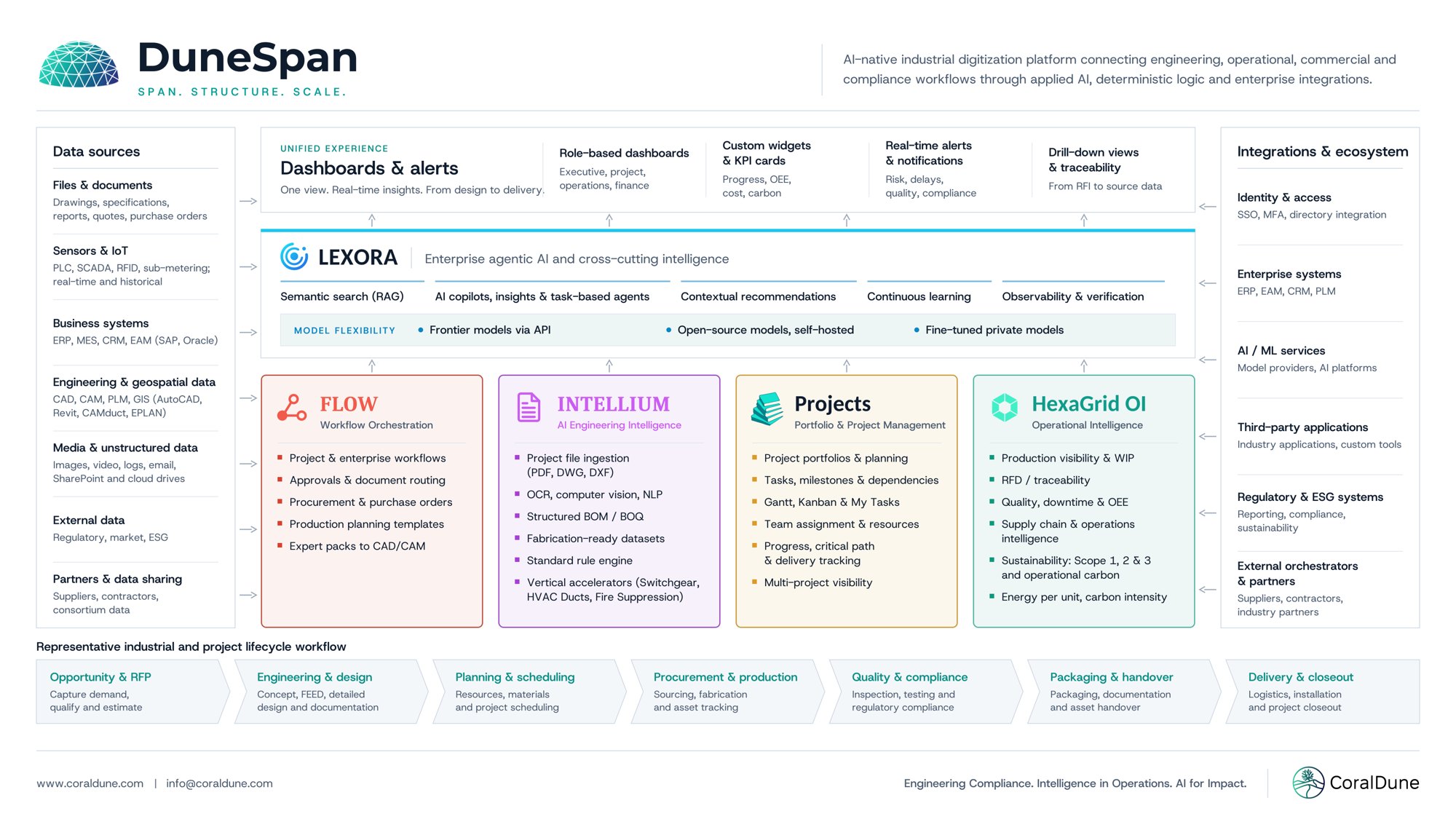
Data sources on the left, integrations and ecosystem on the right. Lexora runs across the top as the enterprise agentic layer; the workflow modules sit beneath it, under one unified experience.
The modules
What each module does

Intellium
Reads and calculates
Turns drawings, RFQs, specifications and schedules into structured BOMs, BoQs, fabrication lists and costing datasets, with deterministic engineering rules and engineer review.

Lexora
Remembers and reasons
The enterprise agentic layer: cited copilot answers, specialist agents and federated queries across documents, ERP and shop-floor data, on a semantic backbone.

HexaGrid OI
Sees
A shop-floor control tower: WIP, genealogy, OEE, quality, downtime, supply chain and carbon, with exception-to-action orchestration.

FLOW
Moves
Routes engineering and commercial work through approvals, with revision states, procurement steps and a full audit trail.

PROJECTS
Delivers
Turns won work into plans: portfolios, tasks, milestones, dependencies and delivery tracking across projects.
The organisation spine
Configured once, read by every module
Every entity, site, team, asset and project is one kind of record, a context node. Four coordinated hierarchies, linked by typed, dated relationships, give every module the same context and the same access rules.
Linked, never nested. Allocated to departments, sites or projects, so one cost centre can span several.
The rules
Every entity, site, team, asset and project is a context node with one ID.
Each node has one parent; real-world overlaps live in typed links.
Default deny, then role grants, then controlled inheritance down the tree. Lexora retrieves nothing outside a user's scope.
Structure is effective-dated: permissions use today's, reports use the period's.
Two layers
Workflow first. Then the enterprise AI layer.
Intellium, HexaGrid OI, FLOW and PROJECTS digitize engineering, operational, commercial and sustainability workflows. Once the work is structured, Lexora puts agents to work across it.
Structured work
- Engineering ingestion and estimation
- Approvals, revisions and audit
- Projects, tasks and milestones
- WIP, QC, OEE and carbon
Governed agents
- Cited copilot answers
- Specialist agents
- Anomaly and exception alerts
- Federated queries across systems
Connectivity
Connects to what you run, instead of replacing it
Business systems
ERP and CRM such as SAP, Oracle, Microsoft Dynamics and Odoo; finance and procurement data.
Engineering
AutoCAD DWG and DXF, PDF drawings, EPLAN, CAMduct and other CAD and CAM tools.
OT and edge
PLCs, SCADA and historians via OPC UA, MQTT, Modbus and WebSocket gateways; RFID and energy meters.
Documents and intake
SharePoint and cloud drives, email and portal intake, standards and manuals.
Identity and security
SSO, MFA and directory integration, role-based access, credential proxy for agents.
AI models and tools
Frontier models via API, open-weight models self-hosted, tool access through MCP.
Named products are examples of systems in scope. Connectors and protocols are scoped and validated per deployment.